
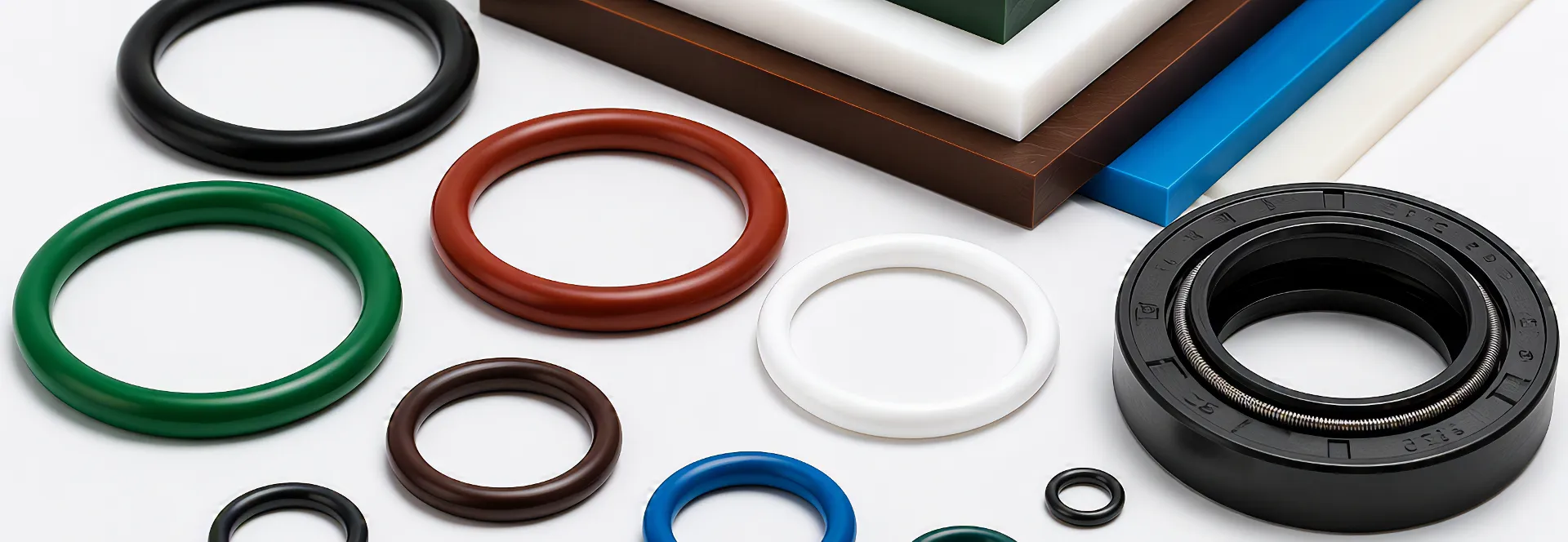
How to choose the right rubber for a gasket or seal depending on the working fluid
The choice of material for a gasket, O-ring, or seal should not be based solely on size, hardness, or price. One of the most important factors for ensuring a leak-proof seal and preventing premature failure is the chemical compatibility between the elastomer and the fluid it will be in contact with. Oils, greases, fuels, water, steam, solvents, acids, bases, glycols, or food products can behave very differently with each type of rubber. Therefore, before selecting a gasket or seal, it is always advisable to analyze the fluid, the operating temperature, the concentration, the exposure time, and the actual service conditions.
The chemical compatibility table accompanying this article compares various fluids with the most common sealing materials: NBR, FPM/FKM, EPDM, VMQ, CR, FFPM/FFKM, FVMQ, HNBR, and PTFE. The table allows you to assess the behavior of each material with a specific substance at a given temperature, using a general compatibility rating. A favorable rating indicates good material performance, while an unfavorable rating suggests potential chemical attack, swelling, loss of mechanical properties, or a reduction in the gasket’s lifespan.
Why does the fluid type so greatly influence the choice of material?
Each elastomer has a different chemical structure and, therefore, a different resistance to oils, hydrocarbons, water, steam, ozone, acids, bases, or solvents. A material that performs perfectly in mineral oil may quickly fail in steam or brake fluid; similarly, a rubber that is excellent for hot water may not be suitable for gasoline, diesel, or petroleum-based oils.
When chemical incompatibility exists, the gasket can swell, harden, crack, lose elasticity, deform, or even disintegrate. In the case of a seal, a poor choice of elastomer can also lead to leaks due to loss of contact with the shaft, premature wear of the sealing lip, or accelerated degradation caused by temperature and lubricant. For this reason, the correct selection of rubber is an essential part of the design and maintenance of any sealing system.
NBR: the usual choice for oils and general industrial uses
NBR, also known as nitrile rubber, is one of the most widely used materials in industrial gaskets and seals. Its main advantage is its excellent resistance to mineral oils, greases, lubricants, diesel fuel, and many petroleum-based hydraulic fluids. For this reason, it is a very common choice in hydraulics, lubricated pneumatics, industrial machinery, automotive applications, gearboxes, pumps, motors, and general maintenance equipment.
However, NBR is not the best choice when the gasket must withstand ozone, weathering, steam, high-temperature hot water, ketones, certain polar solvents, or glycol-based brake fluids. In these cases, it is usually preferable to consider alternatives such as EPDM, FKM, HNBR, FVMQ, or PTFE, depending on the specific fluid and temperature.
FKM / FPM: High resistance to oils, fuels and temperature
FKM, also called FPM or commercially known as Viton®, is one of the most widely used elastomers when greater chemical and thermal resistance is required than that offered by NBR. It is often an excellent choice for oils, fuels, hydrocarbons, many chemicals, greases, vacuum applications, and high-temperature applications.
It is commonly used in seals, O-rings, flat gaskets, and sealing components for the chemical, petrochemical, automotive, gas, machinery, pump, and valve industries. It generally offers significantly superior performance against hydrocarbons and hot oils compared to more basic elastomers. However, it should not be considered a universal material: certain brake fluids, amines, ketones, strong bases, or steam may require other materials.
EPDM: water, steam, glycols and cleaning products
EPDM is one of the best elastomers for applications involving water, hot water, steam, glycols, aqueous solutions, detergents, cleaning products, ozone, and outdoor conditions. It is also widely used in the food industry, water treatment, air conditioning, heating, cooling circuits, and outdoor applications.
Its main limitation is its low compatibility with mineral oils, petroleum-based greases, gasoline, diesel, and hydrocarbons. Therefore, if a gasket or seal will be in contact with oil, lubricant, or fuel, EPDM should generally not be chosen unless the compatibility chart and actual conditions indicate otherwise.
VMQ / silicone: temperature, flexibility and food applications
VMQ silicone stands out for its wide temperature range, good low-temperature flexibility, excellent ozone and weather resistance, and availability in compounds suitable for food and pharmaceutical applications. It is widely used in static seals, food processing equipment, medical applications, lighting, ovens, air conditioning, and equipment where elasticity at extreme temperatures is critical.
Conversely, silicone typically has poorer mechanical strength, lower tear resistance, and less favorable performance against many oils, fuels, and solvents compared to other engineering elastomers. Therefore, in dynamic seals or applications involving friction, pressure, or abrasion, its suitability should be thoroughly validated.
HNBR: an evolution of NBR for more demanding conditions
HNBR can be understood as an evolution of NBR for more demanding applications. It offers better resistance to temperature, ozone, aging, and certain fluids than conventional nitrile, while maintaining good compatibility with oils, greases, and fuels. It is commonly used in hydraulics, automotive, gas, industrial machinery, process equipment, and applications where standard NBR may fall short.
This is especially useful when looking for a gasket or seal with a longer lifespan than NBR, but without the cost or characteristics of an FKM or FFKM. However, as always, the temperature and specific fluid should always be checked against the table.
FVMQ: Fluorosilicone for fuels and low temperature
FVMQ, or fluorosilicone, combines some of the advantages of silicone with improved resistance to fuels and hydrocarbons. It is a popular choice in aerospace, automotive, fuel systems, and other environments where low-temperature flexibility and better fuel compatibility than conventional silicone are required.
However, it does not automatically replace the FKM or FFKM. Its selection should be made when the combination of low temperature, fuel, and elasticity justifies its use.
CR / neoprene: balanced performance for general use
CR, also known as neoprene, offers balanced performance against weathering, ozone, certain oils, refrigerants, and general industrial applications. It is used in gaskets, profiles, diaphragms, supports, hoses, and technical parts where a compromise between mechanical strength, aging resistance, and moderate chemical compatibility is desired.
It is not usually the first choice for aggressive fuels, hot oils, strong solvents or critical chemical applications, but it may be suitable in general environments where there is no extreme chemical requirement.
FFKM/FFPM: maximum chemical resistance and high temperature
FFKM, also listed as FFPM in some tables, is a very high-performance perfluoroelastomer. It is used when maximum chemical and thermal resistance is required within an elastomeric solution. It is common in the chemical, pharmaceutical, and semiconductor industries, as well as in aggressive processes, high-temperature applications, and other applications where gasket failure is very costly.
Its price is higher than that of other elastomers, so it is usually reserved for truly critical applications, very aggressive fluids, or processes where NBR, EPDM, FKM, HNBR, or FVMQ do not offer sufficient safety.
PTFE (Teflon): excellent chemical resistance, but with less elasticity
PTFE, or Teflon®, is not a rubber but a technical fluoropolymer. However, it appears in many compatibility charts because it offers broad chemical resistance to numerous aggressive fluids. It is a common solution for gaskets, rings, guides, bearings, machined parts, encapsulated seals, and applications where chemical resistance is paramount.
Its main difference from an elastomer is that it lacks the same elasticity and recovery capacity. Therefore, when a seal with an elastic effect is required, encapsulated FEP/PFA gaskets with a silicone core, FKM, or EPDM can be used, or special designs that combine PTFE with energizing systems.
How to properly use a chemical compatibility chart
A chemical compatibility chart should be interpreted as a technical guide, not as an absolute guarantee of performance. To make the right decision, it’s advisable to check the exact name of the fluid, the indicated temperature, the concentration, whether the contact will be continuous or intermittent, whether the application is static or dynamic, and whether there are product mixtures. A static seal in occasional contact with a chemical at room temperature is not the same as a seal operating continuously under temperature, pressure, speed, and friction.
In the accompanying table, each fluid is compared with different materials and temperatures, allowing for quick identification of which rubbers perform best and which exhibit moderate or severe degradation. This information is especially useful for avoiding common mistakes, such as using EPDM with mineral oils, NBR with ozone or severe weathering, silicone with fuels, or standard rubber in the presence of aggressive solvents.
Classification of the material's behavior in the presence of different substances
A: Good Behavior
B: Moderate aggression
C: Strong aggression
D: No data, probably adequate
E: No data available, probably adequate
| FLUID | TEMP. °C | NBR | FPM | EPDM | VMQ | CR | FFPM | FVMQ | HNBR | PTFE |
|---|---|---|---|---|---|---|---|---|---|---|
| LIGNITE AND COAL BASED OIL | 20 | C | A | C | E | C | D | A | ||
| LIGNITE AND COAL BASED OIL | 60 | C | A | C | E | C | D | A | ||
| CAMPHORATED OIL | 20 | A | A | C | E | C | E | A | ||
| ANIMAL OIL | 60 | A | A | C | B | C | A | A | ||
| ASTM OIL No.1 | 100 | A | A | C | A | A | A | A | A | A |
| ASTM OIL No.2 | 100 | A | A | C | A | A | B | A | A | A |
| ASTM OIL No.3 | 100 | A | A | C | B | A | B | A | B | A |
| ASTM OIL No.4 | 100 | B | A | C | C | C | B | A | ||
| ATF OIL | 100 | A | A | C | B | A | B | A | A | A |
| WHITE OIL | 20 | A | A | C | A | A | B | A | A | |
| BUNKER OIL | 60 | B | A | C | B | D | C | A | B | |
| CAMPHORATED OIL | 20 | A | B | C | E | A | C | E | B | |
| FUEL OIL | PETROLEUM BASED | 20 | A | A | C | A | A | A | ||
| FUEL OIL | PETROLEUM BASED | 60 | A | A | C | A | B | A | ||
| CRUDE OIL | 20 | A | A | C | B | A | B | A | B | |
| FIR OIL | 60 | A | A | C | B | C | A | |||
| TAR OIL | 20 | C | A | C | E | A | C | E | C | |
| ANILINE OIL | C | B | B | C | C | B | ||||
| PEANUT OIL | A | A | B | A | B | A | ||||
| CASTOR OIL | A | A | B | A | A | A | ||||
| COCONUT OIL | 60 | A | A | C | A | A | B | A | A | |
| COCONUT OIL | 80 | A | A | E | D | A | B | D | A | |
| CUTTING OIL | A | A | C | C | B | A | ||||
| BONE OIL | 60 | A | A | C | B | A | C | A | A | |
| LIVER OIL | 20 | A | A | A | A | A | A | |||
| LAVENDER OIL | 20 | B | A | C | C | A | C | B | B | |
| LINSEED OIL | 100 | B | A | C | A | C | D | |||
| LINSEED OIL | 60 | A | A | C | A | A | D | |||
| WOOD OIL | A | A | C | C | B | B | ||||
| CHINA WOOD (TUNG) OIL | A | A | C | C | B | B | ||||
Beyond the fluid: other factors that also matter
Although chemical compatibility is essential, it is not the only selection criterion. For a gasket or seal, the following factors must also be considered: minimum and maximum temperature, pressure, type of movement, shaft speed, lubrication, surface finish, material hardness, presence of abrasives, food or pharmaceutical regulations, exposure to ozone, UV radiation, weathering, and the possibility of CIP/SIP cleaning or contact with steam.
At OSN we can supply O-rings, seals and sealing solutions in a wide variety of materials, including NBR, HNBR, EPDM, VMQ/silicone, FVMQ, FKM/Viton®, FFKM, CR, FEPM/AFLAS®, PTFE and other technical materials, plus food-grade, detectable, encapsulated or custom-made options.
At OSN we help you choose
Choosing the right rubber for a gasket or seal is key to ensuring a watertight seal, extending the component’s lifespan, and preventing leaks, production downtime, or breakdowns. The question shouldn’t just be “what size do I need?” but also “what fluid will the gasket be working with, at what temperature, and under what conditions?” A chemical compatibility chart allows you to quickly compare the most common materials and select the most suitable option for each application.
When in doubt, especially with aggressive chemicals, mixtures, high temperatures, or critical applications, it’s best to check the fluid’s compatibility with the material and consult a sealing specialist before manufacturing or installing the gasket. At OSN, we help you select the most suitable material for each application, whether for standard gaskets, seals, O-rings, custom parts, or special sealing solutions.


