
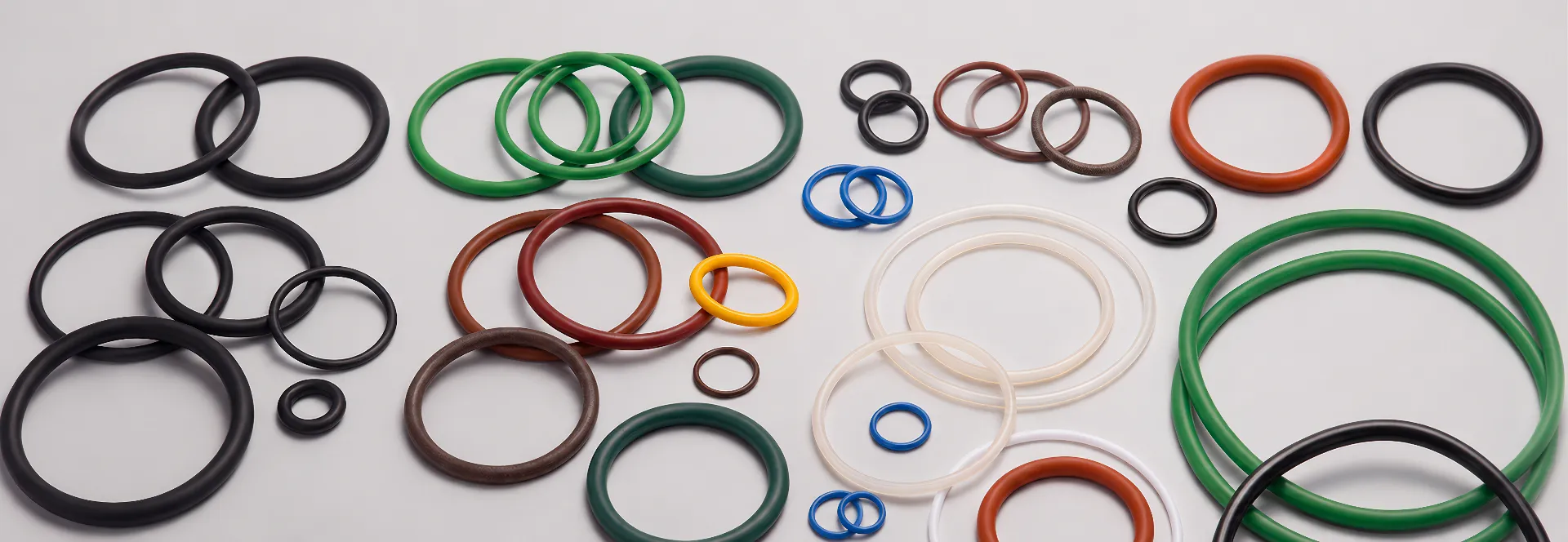
What materials can an O-ring be made from?
At OSN, everything is possible in O-rings: Any material, any hardness, any color
O-rings, also known as O-rings, are one of the most widely used sealing elements in industry thanks to their simplicity, reliability, and versatility. However, they are often associated only with the classic black NBR ring, when in reality, there are hundreds of possible combinations of materials, hardnesses, colors, sizes, and certifications available today.
At OSN, we have extensive experience in manufacturing and supplying all types of standard, custom-made O-rings for virtually any industrial application. From small O-rings with a 1 mm inner diameter and 0.5 mm cross-section to large O-rings with an inner diameter of over 3 meters and cross-sections exceeding 25 mm, we adapt to the specific requirements of each project.
Furthermore, for special manufactures or dimensions outside the catalog, we offer approximate delivery times of 4 weeks, allowing for fully customized gaskets without the need for large investments in tooling.
A huge variety of options depending on the application
Material selection is one of the most important aspects to ensure the proper functioning of an O-ring. Factors such as temperature, the fluids in contact, pressure, and regulatory requirements will determine the best option.
The wide range of available materials allows for applications ranging from cryogenic temperatures to high-temperature processes. Depending on the compound selected, it is possible to work from approximately -250 °C (PTFE and UHMWPE) to +350 °C (FFKM), covering sectors as diverse as food, chemical, pharmaceutical, automotive, water treatment, energy, and industrial machinery.
| Family | Name / Variant | Hardness (Shore A) | Service temperature | Default colour |
|---|---|---|---|---|
| NBR (Nitrile/Buna-N) | Standard NBR | 40/45 to 90/95 | -30°C to +100°C | Black |
| NBR | NBR Fabric | 40/45 to 90/95 | -20°C to +100°C | Black |
| NBR | Food-grade NBR | 60/65 to 85/90 | -30°C to +100°C | Green |
| NBR | Low-temperature NBR | 45/50 to 90/95 | -50°C to +100°C | Black |
| NBR | High-temperature NBR | 60/65 to 90/95 | -30°C to +120°C | Black |
| NBR | Peroxide-cured NBR | 60/65 to 90/95 | -30°C to +120°C | Black |
| NBR | NBR + PTFE blend | 80/85 | -30°C to +100°C | Black |
| NBR | NBR Kevlar Fabric | 70/75 | -30°C to +100°C | Black |
| NBR | NBR (machined) | 87/90 | -30°C to +100°C | Black |
| HNBR (Hydrogenated) | Standard HNBR | 60/65 to 90/95 | -30°C to +150°C | Black |
| HNBR | HNBR Fabric | 60/65 to 70/75 | -30°C to +130°C | Black |
| HNBR | Food-grade HNBR | 70/75 to 80/85 | -30°C to +150°C | Green |
| HNBR | Low-temperature HNBR | 60/65 to 85/90 | -45°C to +150°C | Black |
| XNBR (Carboxylated) | XNBR | 60/65 to 90/95 | -30°C to +100°C | Black |
| CR (Neoprene®) | Neoprene® | 40/45 to 90/95 | -40°C to +120°C | Black |
| CR | Neoprene® Fabric | 40/45 to 90/95 | -20°C to +100°C | Black |
| NR (Natural rubber) | Natural rubber | 40/45 to 90/95 | -40°C to +80°C | Black |
| ACM (Polyacrylate) | ACM | 70/75 to 80/85 | -10°C to +170°C | Black |
| IIR (Butyl) | Butyl | 60/65 to 80/85 | -40°C to +120°C | Black |
| IIR | Butyl rubber + 1/2-ply fabric | 60/65 to 80/85 | -40°C to +100°C | Black |
| EPDM | Standard EPDM | 50/55 to 90/95 | -40°C to +120°C | Black |
| EPDM | Food-grade EPDM | 60/65 to 80/85 | -40°C to +100°C | Green |
| VMQ (Silicone) | Standard silicone | 30/35 to 80/85 | -60°C to +200°C | Red |
| VMQ | Food-grade silicone | 50/55 to 80/85 | -60°C to +200°C | Green |
| VMQ | Low-temperature silicone | 70/75 | -70°C to +200°C | Red |
| FVMQ (Fluorosilicone) | Fluorosilicone | 60/65 to 80/85 | -70°C to +220°C | Blue |
| SBR | SBR | — | -30°C to +170°C | Black |
| PBR (Polybutadiene) | PBR | 70/75 | -50°C to +80°C | Black |
| FKM (Viton®) | Viton® / standard FKM | 55/60 to 90/95 | -30°C to +220°C | Brown |
| FKM | Viton® Fabric | 70/75 to 90/95 | -20°C to +150°C | Brown |
| FKM | Food-grade Viton® | 55/60 to 90/95 | -30°C to +220°C | Green |
| FKM | Low-temperature Viton® | 55/60 to 90/95 | -40°C to +220°C | Black |
| FKM | Viton® GF | 65/70 to 80/85 | -20°C to +210°C | Black |
| FKM | Explosion-proof Viton® | 70/75 to 90/95 | -20°C to +210°C | Black |
| FKM | Viton® Extreme | 70/75 | -20°C to +220°C | Black |
| FKM | Viton® Excellent low temperature | 70/75 and 85/90 | -50°C to +220°C | Black |
| FKM | Viton® Electric resistant | 90/95 | -20°C to +210°C | Black |
| FKM | Viton® Kevlar | 80/85 | -20°C to +210°C | Black |
| FFKM (Perfluoroelastomer) | FFKM | 70/75 and 85/90 | -10°C to +300°C | Black |
| FEPM (AFLAS®) | AFLAS® | 70/75 to 85/90 | -10°C to +220°C | Black |
| Family | Name / Variant | Service temperature | Default colour |
|---|---|---|---|
| PU (Polyurethane) | PU General purpose & Food grade | -40°C to +80°C | Blue |
| PU | PU General purpose | -40°C to +80°C | Blue |
| PU | PU General purpose & Food grade | -40°C to +100°C | Blue |
| PU | PU GG25 | -30°C to +100°C | Red/Blue |
| PU | PU (General Purpose & Food grade) | -30°C to +150°C | White/Red |
| PU | PU (high oil resistance, caprolactone polyester) | -40°C to +150°C | Red/Orange/Blue/Yellow |
| PU | PU (hydrolysis/water, pneumatic applications) | -40°C to +130°C | Green/Blue/Red |
| PU | PU (hydrolysis/water, pneumatic applications) | -40°C to +130°C | Blue/Green/Red |
| PU | Cast PU (Oil resistant) | -30°C to +100°C | Red |
| PU | Cast PU (Hydrolysis Resistant) | -30°C to +100°C | Red |
| PP (Polypropylene) | PP | -20°C to +95°C | Black/Off-white |
| PE (Polyethylene) | LDPE | -70°C to +90°C | Black/Off-white |
| PE | LLDPE | -70°C to +100°C | Black/Off-white |
| PE | HDPE | -70°C to +110°C | Black/Off-white |
| PE | UHMWPE | -250°C to +80°C | Black/Off-white |
| POM (Polyacetal) | Acetal | -40°C to +140°C | White |
| POM | 25% Glass-filled Acetal | -40°C to +160°C | White |
| POM | 15% Glass-filled Acetal | -40°C to +160°C | White |
| POM | Cast Acetal | -40°C to +140°C | White |
| PA (Polyamide/Nylon) | Nylon PA6 | -30°C to +100°C | Black/White |
| PA | Cast Nylon PA6 | -30°C to +100°C | Black/White |
| PA | Cast Nylon PA6 | -40°C to +140°C | Black/White |
| PA | Nylon PA66 + 33% Glass filled | -40°C to +150°C | Black/White |
| PA | Nylon PA66 + 13% Glass filled | -40°C to +150°C | Black/White |
| PPS (Polyphenylene sulphide) | PPS 40% Glass filled | Up to +300°C | White |
| TPE / Hytrel® | Hytrel® TPE 6356 Dupont | -30°C to +100°C | Black/White |
| TPE | Hytrel® Arnitel EM400 / Dupont 4069 | -30°C to +100°C | Black/White |
| TPE | Hytrel® Arnitel PL461 | -40°C to +150°C | Black/White |
| TPE | Hytrel® TPE 7246 Dupont | -40°C to +150°C | Black/White |
| PEEK | PEEK | Up to +280°C | Beige |
| PEEK | 70% PEEK + 10% PTFE + 10% Carbon + 10% Graphite | Up to +280°C | Black |
| PTFE (Teflon®) | Virgin Teflon | -250°C to +250°C | White |
| PTFE | RULON J Gold | -200°C to +250°C | Matt gold |
| PTFE + Bronze | 40% Bronze filled PTFE | -200°C to +260°C | Brown |
| PTFE + Bronze | 40% Bronze + 5% MoS2 filled PTFE | -200°C to +260°C | Brown |
| PTFE + Bronze | 60% Bronze filled PTFE | -200°C to +260°C | Brown |
| PTFE + Bronze | 60% Bronze + 5% MoS2 filled PTFE | -200°C to +260°C | Brown |
| PTFE + Glass | 15% Glass-filled PTFE | -200°C to +260°C | Black |
| PTFE + Glass | 15% Glass + 5% MoS2 filled PTFE | -200°C to +260°C | Black |
| PTFE + Glass | 25% Glass-filled PTFE | -200°C to +260°C | Black |
| PTFE + Glass | 8% Glass + 3% MoS2 filled PTFE | -200°C to +260°C | Black |
| PTFE + Carbon/Graphite | 23% Carbon + 2% Graphite filled PTFE | -200°C to +260°C | Beige |
| PTFE + Carbon/Graphite | 4% Carbon + 7% Graphite filled PTFE | -200°C to +260°C | Black |
| PTFE + Graphite | 15% Graphite filled PTFE | -200°C to +260°C | Black |
| PTFE + Graphite | 15% Graphite + 5% MoS2 filled PTFE | -200°C to +260°C | Black |
| PTFE + Graphite | 25% Graphite filled PTFE | -200°C to +260°C | Black |
| PTFE + Carbon | 15% Carbon filled PTFE | -200°C to +260°C | Black |
| PTFE + Carbon | 25% Carbon filled PTFE | -200°C to +260°C | Black |
| Phenolic fabric | Phenolic Resin Fabric | -20°C to +120°C | Brown |
| Polyester fabric | Polyester Resin Fabric | -30°C to +120°C | Turquoise |
| Family | Hardness (Shore) | Colour |
|---|---|---|
| NBR | 50 to 90 Shore A | Green |
| FKM (Viton®) | 55 to 90 Shore A | Green |
| EPDM | 50 to 90 Shore A | Green |
| Silicone | 60 to 75 Shore A | Green |
| Polyurethane | 90 Shore A | Red |
| PTFE | 65 Shore D | White |
| UHMWPE | 65 Shore D | White |
| Acetal | 85 Shore D | White |
| Material | Hardness (Shore) | Certification | Service temperature | Colour |
|---|---|---|---|---|
| DETECTABLE NBR | 89 (± 5) | FDA, EU 1935/2004 | -30°C to +105°C | Blue |
| DETECTABLE HNBR | 82 (± 5) | FDA, EU 1935/2004 | -30°C to +150°C | Blue |
| DETECTABLE EPDM | 84 (± 5) | FDA, EU 1935/2004 | -50°C to +135°C | Blue |
| DETECTABLE VMQ | 88 (± 5) | FDA, EU 1935/2004 | -60°C to +210°C | Blue |
| DETECTABLE FKM | 87 (± 5) | FDA, EU 1935/2004 | -25°C to +210°C | Blue |
Hardness directly influences sealing capacity, wear resistance, and ease of assembly. At OSN, we can supply O-rings in hardnesses ranging from a minimum of 30 Shore A (very soft silicones), to 65-75 Shore A for the most common applications, or 80 and 90 Shore A for demanding applications. In technical materials such as PTFE, UHMWPE, or acetal, the hardness is typically 60 Shore A on the D scale, which is equivalent to approximately 90 Shore A. Generally speaking, the available range covers approximately 30 Shore A to 90 Shore A, and we can offer special formulations outside these values for specific projects.
Although black remains the most common color, O-rings can now be manufactured in numerous colors to facilitate the identification of materials, fluids, or application sectors. Available colors include brown, green, blue, red, white, beige, and yellow.
Colors are also widely used in food, pharmaceutical, and security applications where quick visual identification is essential. In these cases, blue is the most common color, as few foods are actually blue.
Materials for the food industry
For food contact applications, we have compounds that comply with specific regulations, including food-grade NBR, food-grade HNBR, food-grade EPDM, food-grade silicone, food-grade FKM, food-grade polyurethane, PTFE, UHMWPE, and food-grade acetal, adapting to the requirements of the food, pharmaceutical, and beverage sectors.
Furthermore, we can supply materials detectable by metal detectors and X-rays, specially developed for the food industry, available in detectable NBR, detectable HNBR, detectable EPDM, detectable VMQ (silicone), and detectable FKM. These compounds—like the ones mentioned above—are FDA and EC Regulation 1935/2004 certified, and their characteristic blue color facilitates both visual identification and detection in quality control processes.
When the application requires it, we can manufacture WRAS-certified EPDM O-rings, suitable for contact with drinking water and commonly used in valves, pumps, hydraulic systems, water treatment plants and supply networks.
Solutions for the gas industry and potentially explosive atmospheres
The gas, petrochemical, and energy industries, as well as environments with a risk of explosion, demand materials capable of withstanding hydrocarbons, aggressive gases, temperature variations, and rapid decompression, while maintaining leak tightness and operational safety over extended service periods. At OSN, we offer O-rings for these types of applications using compounds specifically developed for use in valves, regulators, compressors, instrumentation, process equipment, and gas transportation systems.
Among the most commonly used materials for gas applications and ATEX zones are standard FKM (Viton®), FKM GF, low-temperature FKM, explosion-proof FKM (resistant to explosive decompression), AFLAS® (FEPM), HNBR, low-temperature HNBR, FFKM (perfluoroelastomer), virgin PTFE, PTFE filled with carbon, graphite, glass, or bronze, as well as PEEK and PPS reinforced with fiberglass for support and anti-extrusion elements. These materials allow for service temperatures ranging from cryogenic to +300 °C in certain formulations and offer high chemical resistance to gases, oils, fuels, petrochemicals, and aggressive industrial fluids.
For particularly critical applications, we can supply explosive decompression resistant (AED/RGD) compounds, designed to minimize the risk of internal damage when gas pressure drops sharply. Combined with our custom manufacturing capabilities, this allows us to offer tailored solutions for both OEM equipment and maintenance operations in natural gas, biogas, hydrogen, oil, and petrochemical processes.
Urgent manufacturing of O-rings in less than 24 hours
When a breakdown or production stoppage prevents us from waiting for normal manufacturing lead times, OSN SEALS offers emergency solutions to supply custom O-rings in under 24 hours. Thanks to our production systems, we can manufacture large or non-standard O-rings using extruded cord with hot vulcanized bonding, adhesive bonding, or CNC machining, selecting the most suitable technology based on the application, working pressure, and sealing requirements.
These solutions can be manufactured in a wide variety of materials, including NBR, HNBR, EPDM, VMQ (silicone), FVMQ (fluorosilicone), CR (neoprene), FKM (Viton®), FFKM (perfluoroelastomer), FEPM (AFLAS®), PU (polyurethane), PTFE (Teflon®) and PTFE loaded with different additives, allowing them to cover industrial, food, chemical, gas or high temperature applications.
The combination of rapid manufacturing, availability of multiple materials, and the ability to produce diameters from a few millimeters to several meters makes this solution an ideal alternative for urgent maintenance, unforeseen repairs, prototypes, or specific production needs, minimizing downtime and avoiding costly periods of inactivity.
One solution for every application
The combination of thousands of possible dimensions, dozens of material families, multiple hardnesses, special colors and specific certifications makes the O-ring one of the most versatile products on the market.
At OSN, we help our customers select the most suitable solution for every application, whether it’s a standard catalog seal or a completely custom-made product. Because when it comes to sealing, at OSN, anything is possible with O-rings.

