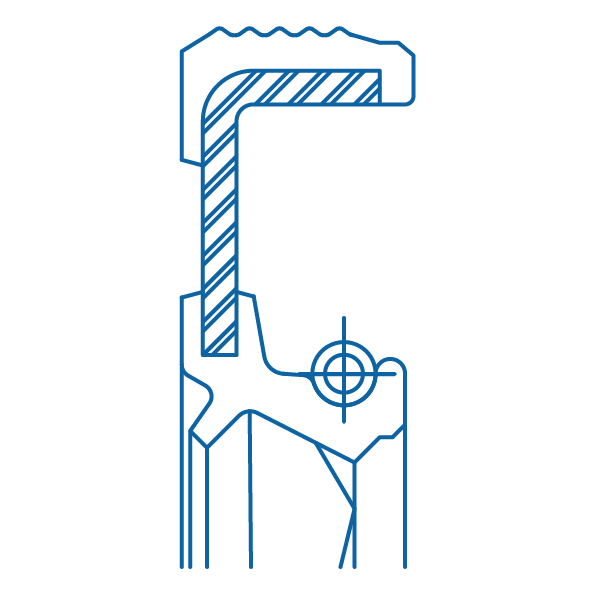
The TGW-BI profile is a dual-material, double-lip rotary shaft seal manufactured with a single metal casing and two distinct rubber compounds. In this design, a secondary compound (typically NBR) is used for the outer elastomer lining, whereas the primary sealing lip—with an integrated garter spring—and the dust lip are molded from a premium elastomer (such as FKM or ACM) to ensure homogeneous sealing performance and superior protection. Additionally, the seal features a corrugated outer diameter (OD) to facilitate installation. The sealing lip is engineered with bidirectional hydrodynamic grooves to match the shaft rotation and effectively control lubricant retention.
See our Installation guide for oil seals to perform a correct installation of the TGW-BI seal.
| ø | ºC | bar | m/s |
|---|---|---|---|
10-790 mm |
-55ºC/225ºC |
≤0.3 bar |
≤10 m/s |
Elastomer
NBR 70-75 Shore A
FKM 75-80 Shore A
VMQ 70-75 Shore A
ACM 70-75 Shore A
EPDM 70-75 Shore A
HNBR 70-75 Shore A
Metal casing
AISI 1060-90 - AISI 304 - AISI 316
Spring
AISI 1060-90 - AISI 302 - AISI 304 - AISI 316
Housing diameter | Metal cage | Elastomeric coating | Housing with grooves |
|---|---|---|---|
| ≤ 50.0 | +0.10 / +0.20 | +0.15 / +0.30 | +0.20 / +0.40 |
| >50.0 ≤80.0 | +0.13 / +0.23 | +0.20 / +0.35 | +0.25 / +0.45 |
| >80.0 ≤120.0 | +0.15 / +0.25 | +0.20 / +0.35 | +0.25 / +0.45 |
| >120.0 ≤180.0 | +0.18 / +0.28 | +0.25 / +0.45 | +0.30 / +0.55 |
| >180.0 ≤300.0 | +0.20 / +0.30 | +0.25 / +0.45 | +0.30 / +0.55 |
| >300.0 ≤500.0 | +0.23 / +0.35 | +0.30 / +0.55 | +0.35 / +0.65 |
| >500.0 ≤630.0 | +0.23 / +0.35 | +0.35 / +0.65 | +0.40 / +0.75 |
When not under pressure, the inside diameter of the sealing lip is always smaller than the shaft diameter. The difference between the two dimensions is known as interference or pre-fitting. Depending on the shaft size, the sealing lip diameter is estimated to be between 0.8 mm and 3.5 mm smaller. It will depend on the setting chosen by each manufacturer.