
V-RINGS VR-VS
Description
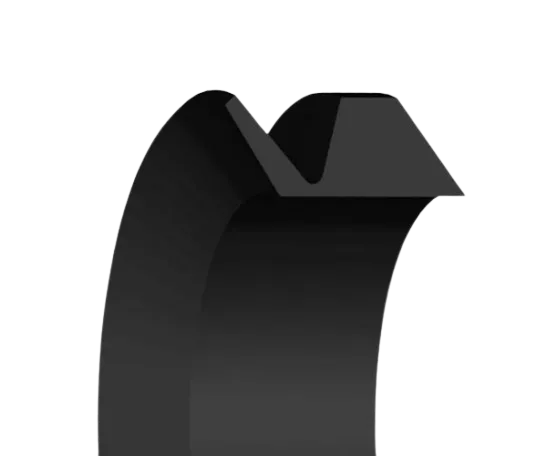
Rotary seal made entirely of elastomer. The seal consists of a body and a front sealing lip. The elasticity of the body, together with the interference between it and the shaft, keeps the seal in place and rotating with the shaft without the need for a specific housing. The lip is exactly the same as the VA, but the body is more robust and the size range is smaller.
Assembly
The VS V-Ring is fitted by slightly stretching it to slide it over the shaft, making sure the lip makes uniform contact with the mating surface, avoiding sharp edges and chamfering corners if necessary, and checking that the seat is clean and perpendicular to the shaft to ensure correct sealing.
Advantages
- Standard design with reinforced body.
- Excellent dynamic sealing effect thanks to the front lip.
- Suitable as a primary sealing element or in combination with radial oil seals.
- Direct installation on the shaft without the need for a specific housing.
- Able to compensate for small axial displacements as well as angular and radial misalignments.
- Friction decreases as peripheral speed increases.
- High body elasticity, ensuring a secure hold by interference with the shaft.
- Effective protection against dust, dirt and splashes of oil, grease or water.
Materials
Available in NBR, FKM, CR, HNBR and VMQ, with hardness between 60 and 80 Shore. These compounds offer an optimal combination of flexibility, chemical resistance and thermal stability, allowing reliable performance against dust, splashes, oils, greases and atmospheric agents. Their elastic structure ensures proper adaptation to the shaft and effective sealing even under misalignment or vibration.
Technical data
- -40ºC/200ºC
- - - -
- < 10 m/s
- 5 - 200 mm
| NO. | d | d2 | C | A | B |
|---|---|---|---|---|---|
| VS-005 | 4.5~5.5 | 4 | 2 | 3.9 | 5.2 |
| VS-006 | 5.5~6.5 | 5 | 2 | 3.9 | 5.2 |
| VS-007 | 6.5~8 | 6 | 2 | 3.9 | 5.2 |
| VS-008 | 8~9.5 | 7 | 2 | 3.9 | 5.2 |
| VS-010 | 9.5~11.5 | 9 | 3 | 5.6 | 7.7 |
| VS-012 | 11.5~13.5 | 10.5 | 3 | 5.6 | 7.7 |
| VS-014 | 13.5~15.5 | 12.5 | 3 | 5.6 | 7.7 |
| VS-016 | 15.5~17.5 | 14 | 3 | 5.6 | 7.7 |
| VS-018 | 17.5~19 | 16 | 3 | 5.6 | 7.7 |
| VS-020 | 19~21 | 18 | 4 | 7.9 | 10.5 |
| VS-022 | 21~24 | 20 | 4 | 7.9 | 10.5 |
| VS-025 | 24~27 | 22 | 4 | 7.9 | 10.5 |
| VS-028 | 27~29 | 25 | 4 | 7.9 | 10.5 |
| VS-030 | 29~31 | 27 | 4 | 7.9 | 10.5 |
| VS-032 | 31~33 | 29 | 4 | 7.9 | 10.5 |
| VS-035 | 33~36 | 31 | 4 | 7.9 | 10.5 |
| VS-038 | 36~38 | 34 | 4 | 7.9 | 10.5 |
| VS-040 | 38~43 | 36 | 5 | 9.5 | 13 |
| VS-045 | 43~48 | 40 | 5 | 9.5 | 13 |
| VS-050 | 48~53 | 45 | 5 | 9.5 | 13 |
| VS-055 | 53~58 | 49 | 5 | 9.5 | 13 |
| VS-060 | 58~63 | 54 | 5 | 9.5 | 13 |
| VS-065 | 63~68 | 58 | 5 | 9.5 | 13 |
| VS-070 | 68~73 | 63 | 6 | 11.3 | 15.5 |
| VS-075 | 73~78 | 67 | 6 | 11.3 | 15.5 |
| VS-080 | 78~83 | 72 | 6 | 11.3 | 15.5 |
| VS-085 | 83~88 | 76 | 6 | 11.3 | 15.5 |
| VS-090 | 88~93 | 81 | 6 | 11.3 | 15.5 |
| VS-095 | 93~98 | 85 | 6 | 11.3 | 15.5 |
| VS-100 | 98~105 | 90 | 6 | 11.3 | 15.5 |
| VS-110 | 105~115 | 99 | 7 | 13.1 | 18 |
| VS-120 | 115~125 | 108 | 7 | 13.1 | 18 |
| VS-130 | 125~135 | 117 | 7 | 13.1 | 18 |
| VS-140 | 135~145 | 126 | 7 | 13.1 | 18 |
| VS-150 | 145~155 | 135 | 7 | 13.1 | 18 |
| VS-160 | 155~165 | 144 | 8 | 15.0 | 20 |
| VS-170 | 165~175 | 153 | 8 | 15.0 | 20 |
| VS-180 | 175~185 | 162 | 8 | 15.0 | 20 |
| VS-190 | 185~195 | 171 | 8 | 15.0 | 20 |
| VS-199 | 195~210 | 180 | 8 | 15.0 | 20 |
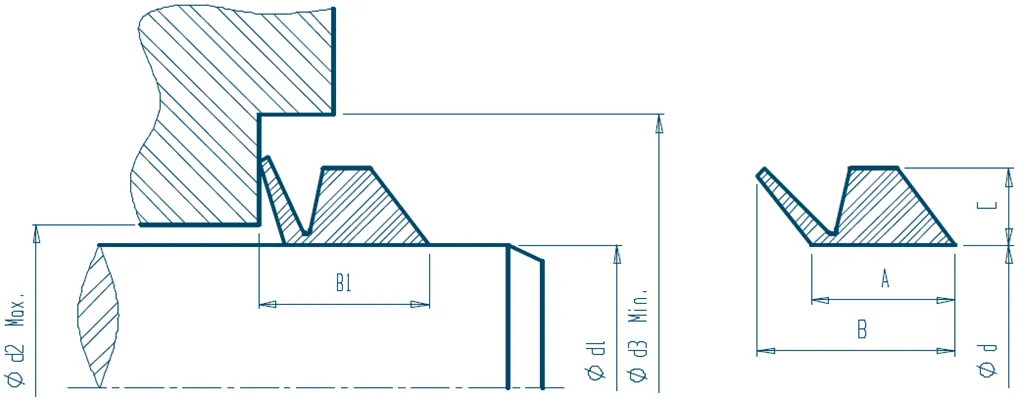
Technical drawing and design dimensions for the assembly of the VR-VS V-Rings
This technical diagram details the geometric parameters needed to check the seating and installation of the seal. It identifies critical variables such as the body width (A), the total width (B), the height (C) and the fitting width (B1). These values allow you to ensure proper perpendicularity and uniform contact on the surface.
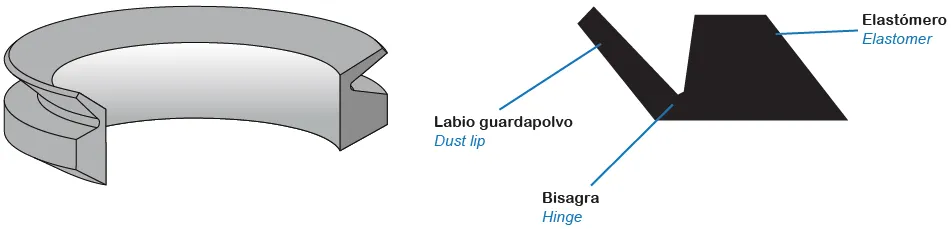
Three-dimensional view and components of the VR-VS V-Rings with reinforced body
This 3D illustration shows the structure of the VS rotary V-Ring seal, designed with a reinforced body to optimize dynamic sealing in industrial applications. You can identify its essential elastomer components: the body, the hinge and the front dust lip. Its elasticity ensures a perfect fit that rotates together with the shaft.

¿Podemos ayudarle?
Nuestro equipo le ayudará a buscar la mejor solución y a elegir el perfil y el material óptimos para su aplicación.

