
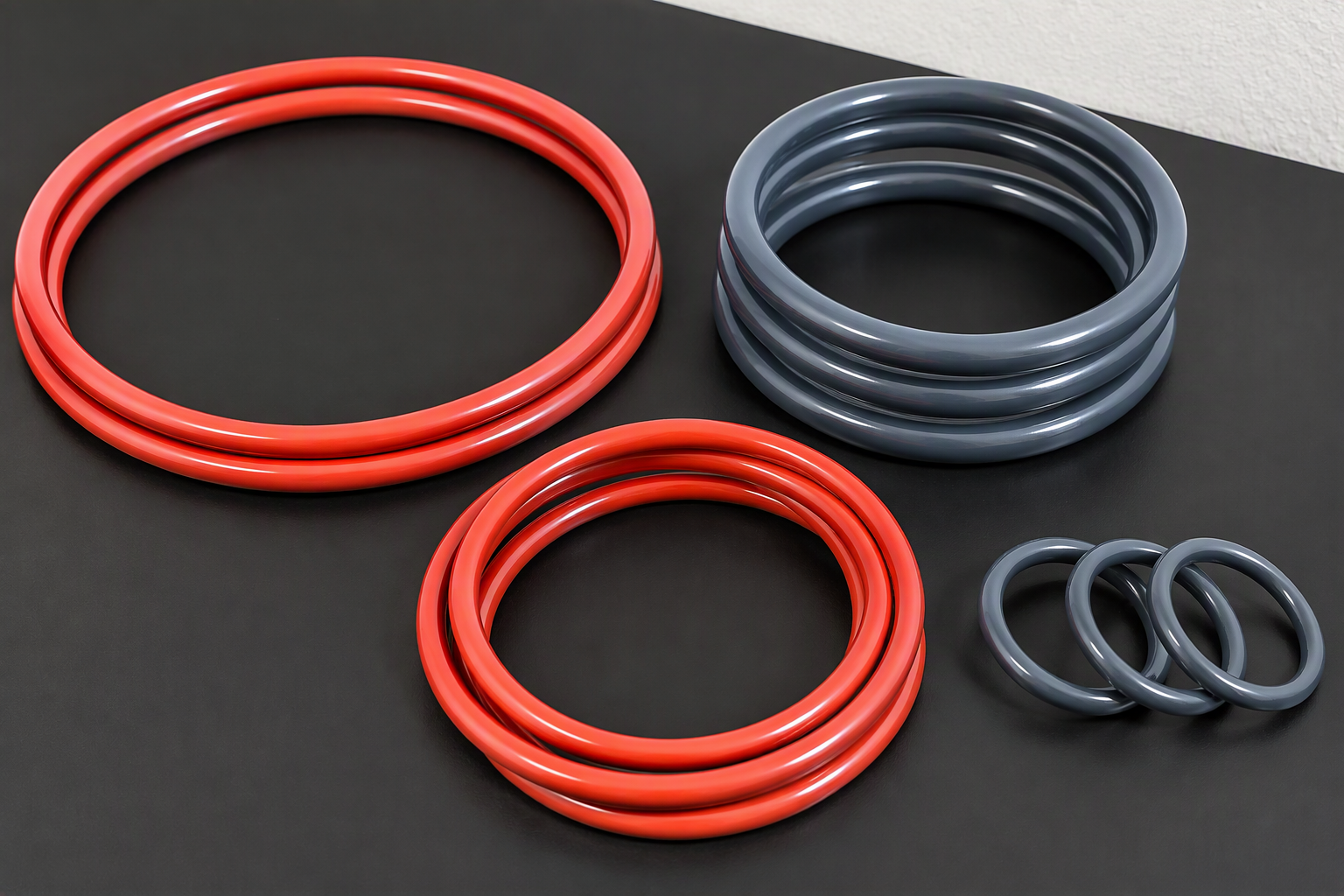
Encapsulated O-rings: When should they be used and how to choose between FEP, PFA, FKM and Silicone?
In certain applications, a conventional O-ring made of NBR, EPDM, FKM or silicone may not provide the required chemical resistance. However, using an O-ring manufactured entirely from PTFE is not always the best solution either, as much of the elasticity and recovery capability characteristic of an elastomer is lost.
This is precisely where encapsulated O-rings provide a particularly effective solution: they combine a flexible elastomeric core with a continuous outer FEP or PFA encapsulation. The core provides elasticity and recovery after compression, while the outer encapsulation provides high chemical resistance and prevents direct contact between the elastomer and the fluid.
This combination makes it possible to solve particularly demanding sealing applications without necessarily resorting to significantly more expensive materials.
FEP is not PTFE: a very common misconception
We frequently receive enquiries requesting a “PTFE-coated O-ring” when, in fact, the customer is looking for an FEP-encapsulated O-ring. Although FEP, PFA and PTFE belong to the fluoropolymer family and share certain characteristics, FEP and PTFE are not the same material, nor do they necessarily describe the same type of O-ring. An encapsulated O-ring consists of a continuous FEP or PFA jacket surrounding an elastomeric core.
In contrast, PTFE-coated O-rings are a different type of product, and their construction and performance should not be confused with those of a fully encapsulated O-ring.
When Do We Recommend Using an Encapsulated O-Ring?
Encapsulated O-rings are particularly recommended when a conventional elastomeric O-ring fails due to chemical incompatibility, swelling, loss of properties or chemical attack by the fluid. They can also be an alternative to solid PTFE O-rings when greater elastic recovery is required. Chemical attack, swelling, compression set and permeation are conditions in which an encapsulated O-ring can replace a conventional elastomer.
Typical applications for encapsulated O-rings can be found in the chemical and petrochemical industries, in equipment such as pumps and valves, reactors and tanks, heat exchangers, autoclaves, filters, piping systems, gas compressors, covers and pressure vessels, and hose couplings. They are also used in the food and pharmaceutical industries, provided that the specific requirements and certifications for each application are verified beforehand.
The high chemical resistance of the encapsulation allows these O-rings to be used with a very wide range of chemicals, solvents and aggressive fluids. However, this should not be interpreted as universal chemical compatibility. Exceptions exist and, under extreme conditions of concentration and temperature, chemical compatibility must be assessed specifically for each application.
FEP or PFA: Which Encapsulation Should We Choose?
This is probably one of the most important questions when selecting an encapsulated O-ring. For most applications, FEP is our first choice. It offers excellent chemical resistance, a low coefficient of friction and a wide operating temperature range. FEP encapsulation has an approximate temperature range of -60 °C to +205 °C, with short-term exposure up to approximately +260 °C. Therefore, for continuous service below approximately 200 °C, FEP is generally the preferred option. In summary: if FEP provides the required chemical compatibility and the temperature does not exceed its operating limit, there is normally no need to switch to PFA.
PFA: When Operating Temperatures Increase
PFA shares many of the excellent chemical properties of FEP but offers one important advantage: greater resistance to elevated temperatures. PFA encapsulation has an approximate operating temperature range of -60 °C to +260 °C, with short-term exposure up to approximately +300 °C.
| Condition | Recomendación |
| General chemical application | FEP |
| Continuous service up to approx. 200ºC | FEP |
| Temperatures above approx. 200ºC | PFA |
| Continuous service at temperatures up to approx. 260ºC | PFA |
| Need for maximum thermal resistance | PFA |
How Important Is the Core Elastomer if the Fluid Is in Contact with the Encapsulation?
It is easy to assume that, since FEP or PFA completely encapsulates the O-ring, the type of elastomer used for the core is irrelevant. This is not the case. The encapsulation is primarily responsible for chemically isolating the core, while the elastomeric core provides the elasticity, recovery and contact pressure required against the sealing surfaces.
In fact, the recovery properties of the O-ring at elevated temperatures depend specifically on the mechanical properties of the silicone or FKM core. Therefore, selecting the correct core material remains essential. For this purpose, we recommend following our elastomer selection guide.
In practical terms, FKM is an excellent general-purpose choice when a firm core with good mechanical recovery is required. The main advantage of silicone (VMQ) as a core material becomes apparent when elasticity must be maintained at much lower temperatures. Silicone is therefore particularly suitable for applications exposed to extreme cold or wide temperature variations.
There is also a third factor that should not be overlooked: permeation. Although FEP and PFA have relatively low gas permeability compared with many other plastics, they are not completely impermeable barriers to all gases. In certain systems involving aggressive gases, these gases may gradually permeate through the encapsulation and reach the core. Therefore, the core material remains relevant even from a chemical compatibility standpoint.
Are They Only Available as FEP/PFA with FKM or Silicone Cores?
Not necessarily. Although FEP/PFA encapsulation with an FKM or VMQ core represents the most common configurations, solutions for specific requirements can also be developed.
At OSN, for example, we can also offer O-rings with a green HNBR core and FEP encapsulation for applications where this combination is suitable. Other configurations with EPDM cores are also available.
This makes it possible to select the most appropriate material combination according to the fluid, temperature, pressure, geometry and required mechanical performance.
OSN Encapsulated O-Rings: Stock Availability and Custom Manufacturing
At OSN, we keep encapsulated O-rings in stock to provide a fast response for the most commonly requested sizes. When the required size, cross-section or material combination is not available, we can manufacture custom encapsulated O-rings with an approximate lead time of just two weeks.
In addition to the standard FEP/PFA + FKM (Viton®) and FEP/PFA + VMQ (silicone) configurations, we can also assess special solutions such as green HNBR cores with FEP encapsulation.
We can also evaluate the operating conditions and help you select the most suitable combination of encapsulation, core material and dimensions. Because in an encapsulated O-ring, it is not only the outer material that matters. The core remains essential to achieving reliable sealing performance.


